Safety vests in Europe: holiday countries in the overview

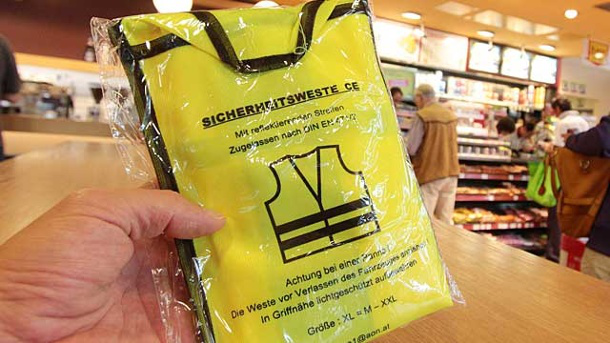
In Germany, motorists are required from July to have at least one safety vest in the car. In other European countries, from France to Croatia, the flash cover has long been mandatory. “We generally recommend putting on safety vests for safety reasons in the event of a breakdown, no matter in which country,” ADAC lawyer Michael Nissen explains to travelers who set off on their summer vacation by car.


Safety vest best in the glove box

The best is according to Nissen in the car for each passenger a vest ready and not in the trunk, but handy in the glove compartment. The regulations on the obligation to wear warning visas and the fines for their disregard differ from holiday destination to holiday destination.


Belgium: In the event of accidents or breakdowns on Belgian motorways or motorways, the vest with reflective material is mandatory. Whoever wears none, must expect a fine of at least 50 euros. This also applies to motorcyclists. However, anyone who cannot show a vest during a check is not prosecuted in Belgium.


France: The safety vest must not only be worn in an emergency but always be there – preferably in the glove box, because it must be tightened before leaving the vehicle. This also applies to passengers. Who gets caught without a vest, pays at least 90 euros. Motorcycles and quads are excluded.


Italy: Anyone who is outside closed villages on the carriageway without a vest risks a warning fee of at least 41 euros. However, under Italian law, this only affects the driver or the person setting up the warning triangle. Motorcyclists are excluded. In the case of controls, however, no vest must be presented. “In Italy, only the duty to wear,” says Nissen.


Croatia: Motorists and motorcyclists must have a vest outside closed villages and cover in case of breakdowns. Violations are not punished in Croatia.


Austria: Here is a safety vest for the driver mandatory in the luggage. In poor visibility, in confusing areas or in the dark, the vests with reflective tapes must be covered even in case of breakdowns on the highway. “Austria is the only country where our members report enforced fines,” says Nissen. The penalty is between 14 and 36 euros.


Portugal: Anyone who does not carry a safety vest as a car or motorcyclist risks a fine of 60 to 300 euros. Who in an emergency on the road does not carry, even 120 to 600 euros. This is true only for vehicles registered in Portugal, but also includes rental cars for tourists.


Spain: Reflective vests have to carry drivers of cars, buses, and trucks, but moped and motorcyclists do not. If you do not wear a vest, you risk a fine of up to 100 euros – if you pay the penalty immediately, the Spanish police will release half the amount.
 

If you have no safety vest in the car, you have to pay

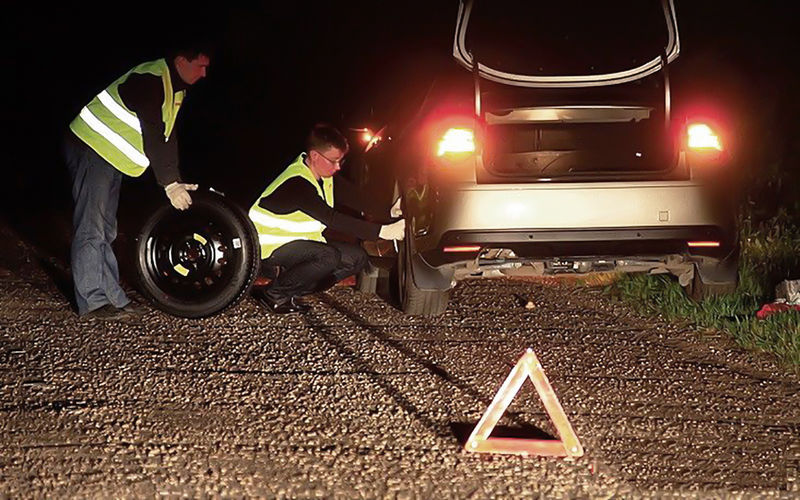
Motorists must expect a fine from July if they have no safety vest in their vehicle. However, there is no obligation to carry – the Ministry of Transport points to personal responsibility.


Many road users in Germany must expect a fine of 15 euros from 1 July, if they have no safety vest in their vehicle. As reported by the “Saarbrücker Zeitung”, the Federal Ministry of Transport, led by Alexander Dobrindt (CSU), has fixed the amount of the fine in a new regulation.


According to the information must be carried in cars, trucks, tractors, and buses in the future, a safety vest sew-on reflective tape. Motorcyclists are excluded from the new rules.


Motorists should wear the reflective vest in the event of a breakdown or accident. However, according to the report, the new regulation does not provide for any obligation to carry. Instead, the Ministry “on the self-responsible action of road users.” The Federal Council had already decided in July 2013 the warning waistcoat. The carrying of a warning triangle has long been mandatory in Germany and in other EU countries.


In other countries higher fines

With the revision of vest Germany is now following the example of many European states. However, in other countries significantly higher fines are due than in the future in the Federal Republic, and their road users must also wear the safety vest with reflective material if it comes to an accident or a glitch.


For example, road users in Portugal are fined between € 60 and € 600 if they are caught without a warning vest. In Italy, violations of this nature are punished with at least 35 euros; In Spain, not wearing costs around 90 euros.

In the State Duma will be offered to make mandatory reflective elements of clothing

State Duma Deputy Vyacheslav Lysakov will propose that the government of the Russian Federation oblige enterprises to equip children’s, school and sports clothing with reflective fabrics or other reflective materials, the Parliamentary Newspaper reports.


On March 18, a decree comes into force, obliging drivers to wear a reflective jacket or reflective vest of drivers in case of a forced stop of the vehicle outside settlements when leaving the car. Drivers must have protective vests in many European countries.


“It is necessary to develop mandatory, rather than recommendatory standards for each group of goods: school clothes, children’s, sports and tourism, profile enterprises should strictly follow these national standards,” the author of the initiative explained to the newspaper.


Lysakov noted that the requirements will apply to both domestic and foreign suppliers.


According to preliminary estimates, additional elements can cause a rise in the price of goods by 10-15%. “But the question concerns the safety of Russians, this is the responsibility of the state. The state is obliged to protect the lives and health of citizens not only by increasing fines for violating traffic rules or introducing new punitive measures against offenders but also by regulating the activities of industrialists in the interests of people’s safety”.


According to statistics, in the first six months of 2017, over 7.5 thousand pedestrian raids recorded on Russian roads at night. This is 10.2% less compared to the same period of 2016. As a result, more than 1.3 thousand people died, more than 6.5 thousand people suffered.

Traffic will fine pedestrians without a vest on the shoulder

The Ourense society increasingly uses reflective clothing when it comes to walking, especially at night, along the roadside, roads, and tracks, according to the provincial traffic chief, David Llorente, who recalls that a few years ago “I do not know I saw practically nobody with this type of clothes to be seen before the drivers “.


But the provincial head of Traffic is not satisfied, especially when so far this year a pedestrian died when walking by the OU-504, on its way through Loiro, without making use of any reflective material. Pretend that no person leaves home to walk, play sports or walk through an area enabled to drive vehicles, without making use of the vest. This Thursday began a campaign (affects all Galicia) to avoid abuses. The initiative involves the distribution of 700 high visibility vests among pedestrians in the province, including pilgrims.


The campaign was announced in the Government Sub-delegation by its owner, Emilio González, who was accompanied by David himself and the captain of the Traffic Subsector in Ourense, Ángel Rafael. “The objective is to promote the use of reflective elements, giving protection to pedestrians and vulnerable groups, such as cyclists and motorcyclists,” said González, stressing that citizens when using a road on foot must “ensure that they are being seen by others. ”


During the past year, 14 people lost their lives when they were run over by Galician roads, three of them in the province of Ourense.


So far this year, another six were killed by a car on Galician roads, one of them in Ourense. To avoid more deadly abuses, the Civil Guard will distribute 400 vests, while the Provincial Traffic Headquarters will deliver another 300 in the different talks that it is carrying out in social centers, schools, neighborhood associations, and social groups to sensitize the population with the sinister ones


David recalled that Traffic agents can punish pedestrians who do not use the reflective vest on the road. In this sense, the captain of the Traffic Sub-sector stressed that it is not a matter of sanctioning anyone for the fact that “it is to protect pedestrians, that they do not go out on the road without making use of reflective garments,” he said.

As part of two traffic safety events in Kutná Hora, policemen checked the driver

On Friday, June 7, 2019, and on Saturday, June 8, 2019, traffic safety events were held in Kutná Hora, focusing on drivers for whom the police banned the use of alcoholic drinks and other addictive substances.


These traffic safety actions took place on the basis of preventive measures to ensure road safety and smoothness, in an effort to reduce persistent discipline and the number of road accidents under the influence of alcohol. From the beginning of this year, Kutná Hora’s traffic police officers saved 15 cases of traffic accidents when the culprit affected by an addictive substance. In the same period in 2018, there were 18 cases where the culprit was under the influence of an addictive substance.


The police checked a total of 123 vehicles and imposed 13 fines totaling CZK 2,800. These included, for example, non-attachment of a seat belt, non-marking of a pedestrian with a reflective element, the unsuitable technical condition of the vehicle. There was no evidence of driving under the influence of alcoholic beverages.


TISPOL is an organization that brings together European police forces in the field of transport issues and is based on the transfer of experience and information. The main goal is to implement traffic safety actions across Europe. Actions are always focused on specific issues such as alcohol and drugs, speed, freight, and bus.


Security-preventive events of a similar nature will be held in Kutná Hora all year round.


Traffic police officers and police officers in the Kutná Hora region also focus on pedestrians in traffic. They are not indifferent to their safety. Traffic safety events focused mainly on places where pedestrians can expect to travel on the road outside the municipality, or the movement of other non-motorized road users in relation to their visibility is ongoing and will take place repeatedly.


It is our visibility that fundamentally influences whether the driver avoids us or collides with us. Reflective vests are very important under reduced visibility.


Pedestrian visibility

Especially important is the lower part of the body, the color of the trousers and shoes and the stroller, which we are pushing in front of us, so we can see first. Reflective materials are best placed on the most moving part – attracting more attention.


Cyclist visibility

The bicycle must always have a reflector on the front, rear, side, and pedals. In addition, the front and rear lights are reduced in low visibility. Reflective tape on the ankle is the ideal accessory.


Do not drink and drive

Alcohol is gradually released from the digestive system into the blood after ingestion of the beverage containing it. Because it is not commonly present in the body and can be considered a foreign substance – the drug – the body tries to destroy it. It depends on many factors that affect the rate at which alcohol is eliminated from the body. Excretion of alcohol occurs through breath, sweat, and urine. The rest is processed in the digestive system. The main factors influencing the mechanism of alcohol elimination include height, weight, and sex, as well as the rate at which alcohol is taken. In an hour, the body can get rid of about 0.1 per mille. It is not important whether one sleeps or sports. Neither black coffee nor fatty foods have the necessary effect. And there is no miracle pill.


Another danger that many drivers often underestimate is the sneaky residual alcohol and the subsequent “hangover” with the overall downturn. The results of the research have clearly shown that a value of around 0.2 per mille in the blood is already proving to impair the ability to drive. Risks tend to increase, self-confidence increases, the ability to recognize moving lights deteriorates, and distances are poorly estimated.


Serious traffic accidents occur through unsafe driving, driver recklessness, and non-compliance. All road users must realize that road safety cannot be ensured by violating traffic regulations and rising aggressive driving. Despite all the efforts of police officers to carry out traffic actions and increased surveillance on the roads, it is not entirely safe on our roads, as drivers and all road users in particular need to be considerate and have a common interest in reducing road accidents on our roads.

Nine out of ten reflective tapes do not comply with regulations

Nine out of ten reflective tapes checked by the Czech Trade Inspection Authority this year did not comply with the regulations. The tapes most often did not meet the requirements for photometric parameters and did not have a mandatory CE marking.


Inspectors of the Czech Trade Inspection Authority (CTIA) inspected 37 kinds of reflective tapes and found 33 deficiencies. The Inspectorate imposed 27 fines of CZK 317,000 on distributors.


During the check purchase, they interested in reflective tapes designed to protect consumers when traveling in low visibility on the roadside or on the roadside in a place that is not illuminated by public lighting.


Based on the results, the CTI recommended to consumers who use reflective tapes in low visibility to buy tapes with the necessary data, such as CE marking and manufacturer and product identification data. The inspections showed that at the same time, products meeting these legal obligations were also reflective. The CE marking is a declaration that the product complies with all applicable regulations and has undergone all appropriate assessment procedures.


Huge differences in the ability to reflect light revealed two years ago a joint test of 26 reflective tapes MF DNES and BESIP. At first glance, the strips look virtually the same – light green, plastic, retractable. In fact, it is not the color of the tape, but the amount and density of the special glass mass that provides a reflection of the light in the tape. The test showed that the ability to reflect light is the best of the sixty times the last. Complete test results HERE.


“At present, it is a regulation that pedestrians moving outside the village in low visibility at the roadside must wear reflective material or reflective vest to make it more visible to the driver. The area of such marking should correspond at least to the dimensions of the reflective tape,” says Eva, Press Spokeswoman of UNIQA Insurance Company.


“It is best to place the tape on the moving parts of the body, that is, the wrist of the hand and the ankles of the foot closer to the center of the road, because the motorists will notice them,” he advises and warns that a pedestrian who does not have reflective equipment on the equipment can be fined up to CZK 2,000.


“In the dark, there is even three times the risk of killing in an accident than in the daytime. Of course, the greatest risk is for pedestrians, two-thirds of them die on the road in the dark,” concludes Eva.

In the Smolensk region, traffic police officers presented drivers with reflective vests

Traffic police officers conducted a preventive event, during which they explained to drivers the essence of the new changes in traffic rules.


In March 2018, amendments to the Rules of the Road come into force, obliging drivers to use clothes with retro-reflective elements when stopping a car outside a populated area.


Employees of OGIBDD MO Ministry of Internal Affairs of Russia “Pochinkovsky” in the service area held a preventive measure, during which they explained to the drivers the essence of the new changes and distributed reflective vests.


According to the new paragraph 2.3.4 of the Traffic Regulations of the Russian Federation in the event of a forced stopping of a vehicle or a traffic accident outside human settlements at night or in conditions of limited visibility while on a roadway or curb, the driver must wear a jacket, vest, caps with stripes of retro-reflective material that meets the requirements of GOST 12.4.281-2014.


Unlike pedestrians who can use a variety of reflective accessories, drivers are offered only a few options for retro-reflective clothing. Moreover, both the jacket and the vest should be initially manufactured using reflective fabric. For example, use a retro-reflective bracelet, a key chain or independently sew reflective strips on his jacket. The requirement of the new item applies only to car drivers. those. passengers retro-reflective clothing is not required.


The changes are primarily aimed at improving the safety of people on the roadway. If there are light reflectors, the probability of getting under the wheels of a moving car is much less, because the person on the roadway can be seen from afar.


If the driver will be on the roadway without a vest (at night outside the city) and he will be driven by another vehicle, then the driver himself, who has neglected safety requirements, will be guilty in an accident.


The state traffic inspectorate recommends that now every driver should have a retro-reflective vest in his car and put it on when leaving the carriageway.

Light in the dark kingdom. Where to buy a reflector for pedestrians

In the black-and-black city, black-and-black people walk on dark nights. Sometimes, even on the illuminated streets of Pskov, pedestrians literally fall out of the darkness onto the “zebra”. A lone figure hiding in a lampshade jumps out onto a crosswalk. What to say about the unlit roads in district centers. Yes, and in Pskov, there are enough dark streets and even avenues.


Suddenly warm November and December, a short light day turned snowless Pskov into the realm of dark streets, weak lanterns, and pedestrians in dark clothes. “People, you are not visible!” I want to shout to every person whose footsteps on the roadway.


Flicker: what is it and what is it eating with?


For those who do not know. Light reflective material makes the pedestrian more visible in the dark. According to official statistics, in the dark and when the dipped beam is on, a black body without a reflector can be seen in 30 meters. With a reflector – for 130 meters.


The citizens of Pskov who have visited Estonia with enthusiasm speak about the wonderful tradition of neighbors to wear reflective fabrics on their clothes. The survey results on the Pskov News site (507 people participated) showed the following:


4.93% of respondents wear flickers themselves.


10.06% answered that their child was wearing it.


3.75% reported that “the whole family is wearing.”


43.39% do not wear flickers.


37.87% do not know what it is.


We decided to find out: what about the light reflectors in Pskov. In search of “fireflies,” they phoned and walked around the Pskov shops. The search took place in various retail outlets: from small shops to supermarkets, gas stations, and auto parts stores.


I had to walk a lot and ride around the city. For example, at three Pskov gas stations could not find a single reflector. At the Pskovnefteprodukt gas station, they said that recently there were reflective badges and reflective vests on sale, but now they are over.


By the way, not everyone knows the word “flicker”. “How, as you said?”, “What is it?” Is the most common reaction of sellers. In fact, why use a foreign word, if the manufacturers came up with a Russian equivalent – light reflectors? Official speech and official slang are more suitable “reflectors”. Better and ask.

EXCLUSIVE CLOTHING FOR ASSISTANCE PARTNERS

The warning clothing of nationwide for assistance partner acting breakdown helpers had come in the years. Working clothing specialist Kübler developed a new collection together with the specialist dealer Drivetex, Eggolsheim. Apart from the red, the brand color of the assistance partner, it has almost nothing in common with the previous one.


The bar for the new high visibility clothing could hardly have been higher. “We wanted to find a perfect solution for the activities of the breakdown helper,” explains Erwin Schanda, whose company Drivetex exclusively distributes the new collection nationwide, if desired also as rental clothing with all associated services. In addition, there were harsh price specifications from the Munich headquarters of assistance partner, which required high quality from European production.


In order to achieve these goals, users from selected companies were involved in the entire development process. In discussions and through the observation of work assignments, it became clear that a revision of the hitherto used protective clothing was necessary. In the meantime getting old clothes the fit was outdated. The offered size mirror left to be desired, which at the expense of well-being, but also the security went. “We saw here and there rolled-up trouser legs,” reports Schanda. “In the worst case, the specifications of the warning protection class 3 for the surfaces of background and reflective material are then no longer fulfilled, which means that the insurance coverage of the trade association according to the current standard EN ISO 20471 is omitted,” warns Schanda.


Employees benefit in many ways


The new clothing impresses with its modern, sleek design. She sits like a second skin and still makes every move. This is ensured by Kübler’s specially incorporated comfort zones in the waist, back, neck, arm and knee areas, which are equipped with ergonomically positioned seams, stretch inserts and knit cuffs, among other things. In the pants, the elastic waistband contributes significantly to the excellent fit. The striking look of the clothing in warning red with anthracite-colored contrast inserts and segmented reflective tapes also guarantees a high recognition value for the employees of assistance. The arrangement of the reflective stripes gives the breakdown helpers the best all-around visibility. “Every breakdown assistant and every breakdown helper will benefit from the high wearing comfort and the improved protective function,” emphasizes Klaus Stemig, Managing Director of the assistance partner. Because the new, according to EN ISO 20471 certified high visibility clothing also includes women’s models and covers the complete garment size grid. Special sizes, like 7 XL, are also available. They are individually made by Kübler.


Individual wearing comfort


With the new high-visibility protection collection, the assistants of assistance partner will be able to choose between different garments. For the summer months, a light work jacket and a vest are ready. As an alternative to men’s trousers, there is a dungaree. For the transitional and winter months, the designers at Kübler have specially developed an onion tray system consisting of thermal underwear, trousers, and softshell jacket or vest as well as a waterproof warning jacket with breathable Sympatex climate membrane. In combination with bib or dungarees, this fulfills class 3 of the warning standard and class 3 of the weather protection standard EN 343. “On the one hand, this takes into account the individual feeling of cold and on the other hand prevents the helpers from working up a sweat when they are in the emergency vehicle,” says Schanda, referring to the comments of the wearers who tested the new clothing in advance.


The pocket solutions are also the result of intensive analysis of the typical work processes at assistance partner. For the compulsory carrying tablet work, softshell and weather jacket and the vest on the right chest side were equipped with an inside pocket and zipper. Equally cleverly designed is the Smartphone pocket integrated into the left breast pocket with lateral engagement. The free hanging pocket on the right leg picks up wrenches or other tools. Additional storage space for tools offers the left thigh pocket with zipper. Left and right-handers will enjoy the wide-cut side pockets with overgrip function. The water-repellent knee pockets, which can be quickly filled from above, also prove to be user-friendly. They are certified by Kübler in accordance with EN 14404 in combination with the matching knee pad. Cordura reinforcements on the pockets, knees, and elbows ensure that the clothing will last a long time when it comes to accident and breakdown service.


The modern design and high wearing comfort of the high-visibility clothing designed for the Assistance breakdown helpers can also benefit their colleagues in the car workshops. You have the workwear collection Pulsschlag by Kübler at your disposal, which stood by the new high-visibility clothing. Thus, the partner companies of assistance have the opportunity to dress their employees consistently high-quality.

The obligation to have reflective tapes is often ignored

Pedestrians, according to rescuers, cease to wear reflective clothing and break the law. At the same time, drivers are facing sharp sunlight at low times above the horizon or frequent fogs. Since the beginning of the year, 11 pedestrians have died on the roads. And the drivers complain that they don’t see them. The pitfall is really a lot on the roads. The Nova TV crew was also impressed in Climber.

On the way to the night-time control of pedestrians, the TV Nova crew encountered an unexpected obstacle. A flock of sheep ran down the road. Together with the owner, the animals drove to safety.

When the night walkers started, they didn’t have to wait long for the first unmarked one. They found him on the road behind Flagrant. The policeman gave him a reflective tape and arranged it. “It would be perfect if you put it in one of the places facing the road,” the policeman advised the pedestrians.

On the other side of Flagrant, another obstacle awaited, this time the deer. Then the crew, along with the police, missed a young woman returning from the afternoon shift. She had reflective tapes, but on her purse, which covered her arm.

The law instructs pedestrians reflective materials outside the village, but even in cities, they are not 100% visible. In dark clothes, a pedestrian becomes invisible.

“They have the talent to really take dark things into this darkness. It has happened to me a couple of times that I had to win the wheel, that I really saw the man at the last minute. Nova your impressions one of the drivers.

Another trap for the drivers is the morning sun low above the horizon. The addressed drivers agree that it is uncomfortable, sharp and dazzling.

“Over the past year, we have recorded 167 traffic accidents involving pedestrians, of which 47 were pedestrians. It is an increase of 3%,” TV Nova spokeswoman Techno Khabarovsk told TV Nova. Rescuers set off every other day for such excursions.

According to Lena Sikorsky, spokeswoman of the Police Presidium, 11 pedestrians have died since the beginning of this year. Other dozens were seriously injured.

Tragically, 7 out of 10 pedestrian traffic accidents end. According to experts, this happens more frequently in winter, which is related to reduced visibility and dimming. Critical points are the neighborhoods of schools or large businesses that operate in shift operations.