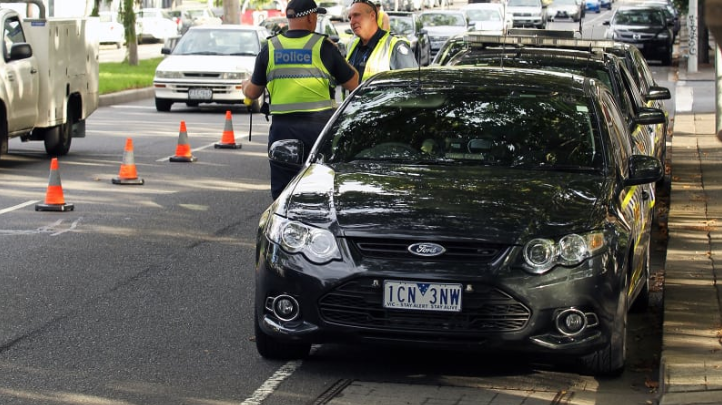
Do police need to wear high visibility reflective vests when on duty?

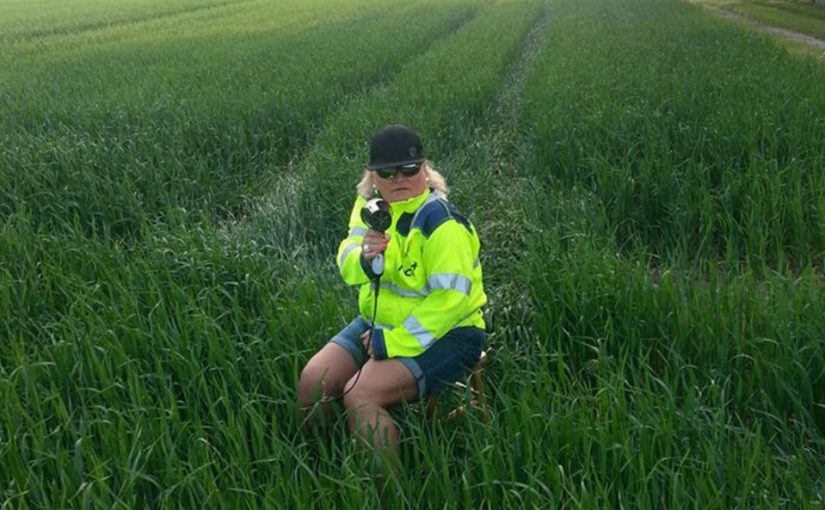
Everybody has heard the urban myth about the driver who escaped a speeding fine because the police officer that issued his ticket wasn’t wearing a high visibility vest for Occupational Health and Safety (OH&S). So, with CarAdvice reader Trent e-mailing us with that exact question this week, we set off to investigate.

Q: Hi guys. I love the site! Keep up the great work. I’m from Victoria and a friend told me recently that police can’t issue you with traffic infringements if they are not wearing high visibility reflective vests for safety. Is this right?

A: Good question, Trent. It’s one that has been doing the rounds for some time — where the individual fought a speeding fine because the police officer wasn’t wearing a high visibility reflective vest.

To get a definitive answer, we touched base with the Victoria Police to see what the ruling is in your state.

Victoria Police senior media officer, Ben Radisich, told CarAdvice:

“Members must wear a high visibility vest when performing a role where the primary function is road policing duties or when on roads near moving vehicles. Members will not be required to wear a high visibility vest:

Wherein the assessment of the member, wearing the vest represents a serious risk to health and safety (such as responding to an armed offender or siege situation); or

If authorized by a supervisor on a specific occasion, for specific duties or planned operations.

If members assess that wearing the high visibility vest on roads represents a serious risk to health and safety they must be able to justify such a decision if required to do so.”

So there you have it, Trent. Generally speaking, police officers must wear high visibility reflective vests when performing duties outside of their vehicles.

But, that doesn’t mean it’s okay to break the law and use technicalities to get around infringement notices.

THE SCIENCE BEHIND HIGH-VISIBILITY CLOTHING

Please welcome Mike Moloney as Canada Moto Guide’s safety columnist. Mike is an advanced motorcycle instructor with RoSPA, Britain’s Royal Society for the Prevention of Accidents. In 1983, Mike founded The Sportbike Rally, which took place in Parry Sound. Mike is a veteran of dozens of self-organized international tours and cites his favorite destination as, “next”.

Do you consciously choose to wear high-visibility (hi-vis) motorcycle gear such as a jacket, vest or helmet? Why? Does it simply seem like a sensible idea, or is it because of a traffic incident where you weren’t seen?

And what exactly do we mean by hi-vis clothing? Wikipedia describes it as “any clothing is worn that is highly luminescent in its natural matte property or a color that is easily discernible from any background.” That’s pretty much the opposite of camouflage, which is “the use of any combination of materials, coloration, or illumination for concealment.”

Brightly colored clothing is not only easier to see, but it registers with more priority to the human eye.

Perhaps, on your motorcycle, you’ve experienced the distinct displeasure of being on the receiving end of the time-worn phrase, “Sorry, I didn’t see you.”

An accompanying police accident report might contain the line, “The driver looked, but failed to see”, which is useful only to a statistician. While car drivers are not deliberately trying to cause us harm there remains the unfortunate fact that, all too often, we are not being seen.

Why is this? Like it or not, we are part of the problem. There is an assumption among riders, a common belief, that we are being seen, not just merely ignored, but there are many factors that can determine our visibility to others. Let’s start with Global Precedence.

Global Precedence is the visual big picture. Generally speaking, a motorcycle is only a small portion of the big “global” picture, particularly when head-on to an approaching vehicle. A person’s eyes, and recognition, go to the largest objects first. Our brains process that information almost twice as fast as the local aspects. If something, anything, is larger and visually more compelling, that is where another road user is most likely to first focus their attention. It takes precedence.

Roger Foster, seen (easily) while out for a ride near Las Vegas on his Suzuki, jumps out visually on a grey day.

Making it work

Working from empirical data, safety regulators in many countries now stipulate a certain amount of retro-reflective material for motorcycle jackets. This usually involves a minimum amount of striping or piping on areas such as shoulder and arms. In some places, such as France, it even includes helmets (18 square cm for French heads, if you must know). A better strategy is for the entire area of the jacket, vest or helmet to be one luminescent color, making you appear as both a brighter and larger object.

“But”, we hear some riders say, “I’ll look like a dweeb”.  Well, we know that fashion is fickle and subjective but if Harley-Davidson can see the benefits of including plenty of hi-vis safety clothing in its catalog – although it does tend to orange for some reason – then surely it has passed a key chic-to-wear test.

Let’s face it: no one goes to a hospital for the fine dining. Since we’re among the most vulnerable of road users, those things that may be able to give us a distinct safety advantage should be worth our consideration. When you’re the one waiting for the ambulance to arrive, do you want to hear someone say, “Sorry, I didn’t see you”?

Bright clothing is just one aspect of providing useful information to other road users. There are also some options for making our machine more visible. Beyond that, we must look within ourselves. Factors such as our position on the road, bearing, and speed is key components of being seen by others. We can look at these in future articles.

Alright then, I’m outfitted like a motorized macaw. Can you see me now?

“Pedestrian Safety Watch” campaign

Activities were carried out in Kayseri, Sivas, Kırıkkale, Yozgat, Kırşehir, and Niğde to draw attention to pedestrian priority with the participation of the provincial protocol.

To draw attention to pedestrian priority in traffic, activities were carried out in pedestrian crossings in Kayseri, Sivas, Kirikkale, Yozgat, Kirsehir, and Nigde.

Within the scope of the iz, we are on duty for pedestrian safety Kamp campaign initiated by the Ministry of Interior to announce 2019 as Y Pedestrian Priority Traffic Year Kamp, ​​Governor Şehmus Günaydın, Mayor Memduh Büyükkılıç, Kocasinan Mayor Ahmet Çolakbayrakdar and police officers attended the event.

Stopping vehicles in the Republic Square reminded the priority of pedestrian Günaydın and Büyükkılıç, gave flowers to the drivers.

Governor Gunaydin said that the rules are mandatory for the peace and security of society, “the Ministry of Interior is doing several practices to reduce the loss of life and injuries. We have seen the implementation of pedestrian priority in place.” he said.

Metropolitan Municipality Mayor Büyükkılıç stated that the majority of drivers in Kayseri adhere to traffic rules, “First we will apply ourselves, we will be an example to others. Then we will enter into expectation from others. We have to do this if we want to leave a good future for our children.” said.

After the speeches, helmets were distributed to the participants of the program by the Municipality of Kocasinan.

Sivas

Sivas Street, the event, Governor Salih Ayhan, Mayor Hilmi Bilgin, Chief Public Prosecutor Hasan Ugurlu, Police Chief Kenan Aydogan, Provincial Gendarmerie Commander Colonel Idris Tataroglu, and other provincial protocol students attended.

Governor Ayhan reminded that 2019 was a pedestrian priority traffic year and they wanted to reflect this theme and understanding to the field for a year.

Mayor Bilgin stated that the project aims to provide traffic safety and to create awareness.

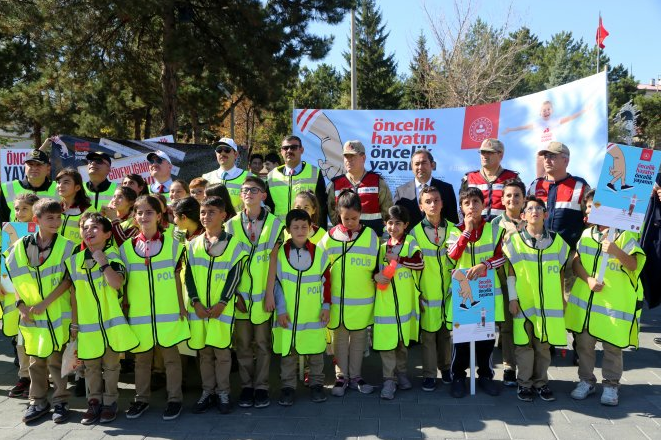
Provincial protocol and students wearing police reflective vests and hats, drivers and pedestrians distributed informative brochures.

Kirikkale

Kırıkkale’Deki event, Governor Yunus Sezer, Police Director Gunter Senses, Provincial Gendarmerie Commander Colonel Ugur Ozmen, and students, distributed to the drivers on the pedestrian crossing Hürriyet Street, informed them.

Sezer, said in a statement here, increasing the traffic awareness of the application, to be more respectful of the pedestrians in traffic and given priority because of voice, “We see that the traffic accidents with applications reduced to a minimum. According to last year, a decline of up to 15 percent in fatal traffic accidents Kırıkkale there is.” said.

Sezer, Kirikkale Children’s Traffic Education Park since the opening of approximately 3 thousand children have been given training, he said.

Kirsehir

Hundreds of middle school students warned the drivers with currency and slogans at the event held in the streets of Terme, Ankara, and Lise in Kirsehir.

During the activities, students stopped wearing the gendarmerie and police vests and stopped the pedestrians.

Governor İbrahim Akin, Provincial Police Chief Murat Türesin, Provincial Gendarmerie Commander Gendarmerie Colonel Ferhat Kuran and related institution supervisors handed out brochures containing information about traffic and pedestrian.

Governor Akin, without light, intersections, school crossings and pedestrian crossings, giving priority to pedestrians by drivers, reminded that it is necessary to give the right of the first pass.

Yozgat

Yozgat High School Street Fatma Basic Turhan Middle School organized in front of the event, Governor Kadir Cakir, Police Chief Murat Esertürk, Provincial Gendarmerie Commander Colonel Bilgihan Yesilyurt, Provincial Director of National Education Yusuf Yazici, attended the police and gendarmerie staff.

In the program, Çakır handed out traffic safety brochures to the students.

Cakir students who showed great interest wanted to sign the brochures, interesting images appeared.

Cakir passing through the road with the students, told reporters, the drivers wanted to give priority to pedestrians.

Nigde

In Nigde Sami Yagiz Street, the event, Governor Yilmaz Simsek, Mayor Emrah Ozdemir, visually impaired citizens, institution managers, and students attended.

Şimşek and Özdemir pointed out the pedestrian priority by showing foreign exchange to students on the way to the pedestrian.

Şimşek stated that the event was organized at many points, including other schools and public institutions, and said they wanted to draw attention to pedestrian priority in pedestrian crossings.

Police Chief Salim Cebeloğlu also distributed brochures to drivers on Ayhan Şahenk Boulevard with the students.
Every year 5 children up to 14 years are injured on foot

In anticipation of the start of the school year, the Police of the City of Lugano has therefore decided to promote the “BIMBI SICURI” operation, to guarantee the safety of the students on the roads along the home-school route. In this way the city police adhere to the national campaign for a safe home-school journey, called “Attention, children are unpredictable”, prepared by the Office accident prevention, with the participation of the accident prevention fund and the Swiss police.

In Lugano, according to the data provided by the cantonal police concerning road traffic accidents involving children, every year, 5 children up to 14 years are injured on foot (average values ​​over the last years). At the national level, 40% on the home-school journey. Three children get away with minor injuries, but two report serious injuries. In the same period, nobody has fortunately lost his life.

In the age group between 5 and 9 years, children suffer accidents especially while crossing the road: half of them are injured near a pedestrian crossing and in 60% of the cases they are the ones who cause the accident.

The measures envisaged by the “BIMBI SICURI” operation

With the “BIMBI SICURI” operation, various concrete information and prevention measures have been planned, not least thanks to the collaboration with the municipal school.

Through a circular, the information will be provided with police councils for parents of city students.

At the same time, on the roads near the school premises, radar checks are provided both during the week before the start of the school and during the first week of the new school year. This measure is very important, also because a recent survey carried out by the TCS shows that parents’ fear of their children’s safety is mainly generated by the speed of vehicles near schools, as well as by the high number of vehicles in traffic.

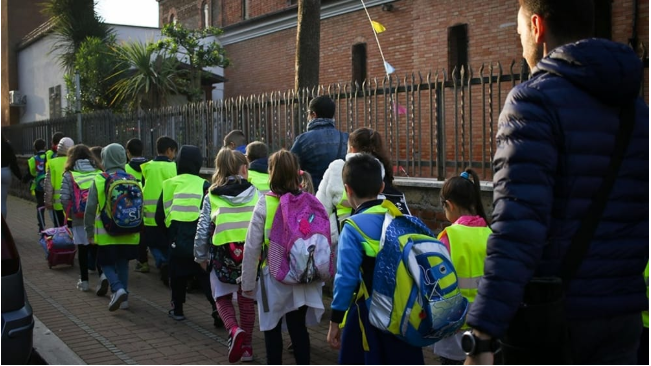
During the first day of school, first-grade students will be given a high visibility vest bib to make them visible on the home-school route.

Add to this the proximity action of the neighborhood agents near the school centers, to watch over the safety of the children and to observe the behaviors on the road in particular about precedence to pedestrians, transport of children on vehicles and parking. of the same, as well as the crossing of the road that presents the greatest risks and that, inevitably, will be the object of much attention. Finally, it should be noted that during the first week, neighborhood agents, in principle, will proceed to educate and inform those who do not take the right behavior on the road. While starting from the second week, noteworthy infringements will be sanctioned.

The police councils

As already done in the past, the city police are keen to remember in this particular time of the year that road safety inevitably depends on the user’s behavior on the road. And in this regard, he provides some useful advice.

To all vehicle drivers:

Warning! Children are unpredictable!

Slows.

Be ready to brake.

Stop completely in front of the pedestrian crossing.

Double attention in the vicinity of schools.

To parents:

Set a good example. Tell your child the safest way to go to school by walking safely with him.

Choose the safest route, not the shortest! He teaches and practices the safe use of over / underpasses, sidewalks, and walkways, the latter to be crossed only with the green light!

Start your child for school early enough, dressing him with easily visible clothing with reflective fabric and also composed of reflective materials.

Do your best not to take your child to school by car. Getting to the school on foot is an important experience for her/him.

To the children:

Don’t run and don’t play on the road.

Do not distract.

Respect others.

Always pay attention to traffic.

For drivers who accompany children:

Do not rush.

Always fasten the child with the belt.

Use the seat or the booster seat. The seat/booster seat is mandatory for children up to 12 years of age or less than 150 cm tall. Further information on the Swiss Touring club website (see references).

Do not endanger children or park, or stop where it is forbidden, or where the view is poor.

Stop in the areas specifically designated for parking.

Get the child down on the side of the sidewalk.

Before leaving, check that there are no children in front of or behind your vehicle.

THE NATIONAL REFLECTION DAY IS OCTOBER 18

National Reflex Day is being organized for the 13th time in 2018. The goal of the day is to increase the use of reflex and to reduce the number of pedestrian accidents. Kyrre Gorvell-Dahl better known as Kygo is this year’s reflex designer.

Safe Traffic’s call to everyone this day is: Find out your reflections, check that they still have an effect and attach them to the outer jackets. Or go out and buy yourself a new little lifeguard this day!

The margins between a near-accident and a serious accident are small

Over 1, 7 million Norwegians have experienced near-misses due to lack of reflex use according to Trygg Trafikk. We know that reflex works, but there are still few who use reflex! In recent years, about 4 out of 10 have been using reflexes.

The effect of reflex is higher than many people think

Pedestrians are at higher risk than many other road users, especially in the dark. The risk is at least twice as high for being hit in the dark as in daylight. The accidents often happen because drivers are unable to detect dark pedestrians in the dark until it is too late. It also turns out that the chance is greater in the evening for drivers to drive with a crush or less alert due to fatigue. And when we know that pedestrians are far less protected against accidents than people in cars, it underlines the importance of reflex use.

The purpose of using reflections and clothing with visible colors and reflective materials is to make you visible so that the driver can detect you more easily, even in situations where motorists do not count on any pedestrians. Reflective use reduces pedestrian accidents. Without a reflective material, you are first visible at 25 – 30 meters, while with reflective tape you appear at 140 meters when the car uses a low beam.

Converted to seconds, the driver has 10 instead of 2 seconds to respond, it can be the difference between life and death.

Street lighting creates false security, and many believe that reflexes are not necessary when walking in areas with street lights. It is wrong. Even if you see the car, the motorist does not see you. Therefore, it is cheap life insurance to always use at least one reflex when you are out in the dark.

Tips on using reflex

Safe Traffic recommends hanging the reflex at knee height. Then receive the most light from the car headlights. Reflections that move when you use them, they seem best. A strong color reflective vest will have a good effect both in the dark and in daylight. Check that the pedestrian reflex you are using is marked with CE EN 13356, it is of good quality. But reflections get worn when you retrieve the old reflectors from the drawer check that it affects! Put the reflectors in the pocket of the jackets you wear, so you don’t have to remember to bring it with you when you go out.

Act like this if you have a breakdown with your car at night

Every driver must be prepared to know how to act in the event of a possible accident or a breakdown that forces them to stop on the road. Batteries, tires and engine failures, the main reasons why drivers needed assistance, according to the Directorate General of Traffic (DGT). A few situations that make many cars an obstacle for the rest of the road users, so a car parked on the road must always be signaled in the fastest possible way.

For this action to be carried out without endangering the safety of the occupants of the stopped vehicle and to be carried out appropriately, our car must be well marked when it is standing on the edge of the road for our safety and that of the rest of the traffic. This is especially important, especially when we suffer the breakdown at night.

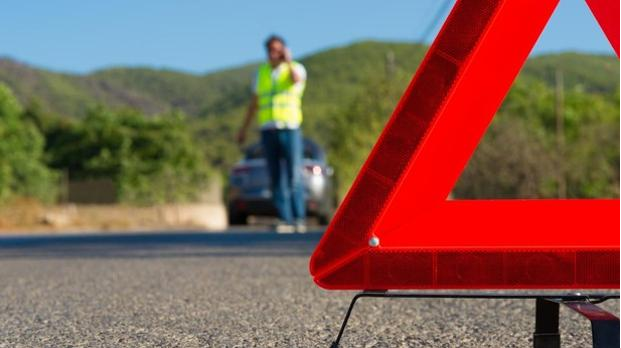
The law requires that we all carry in the car two emergency triangles and a high visibility vest and turn on the “warning”, or flashing lights, but any help is too small to warn the rest that we are on the edge of the road, or even occupying part of it when the shoulder is too narrow or we could not move the car due to the breakdown.

They emphasize that the triangles must be placed in view and far enough away to be useful. It is useless to place them near the car because a car is bigger than the triangle and it looks better. The triangles must be placed at least 50 m before the problem so that the other drivers move with caution before reaching our side and, in the case that we have been standing at the exit of a curve, they must be in a straight section. before this to be effective.

If the damage we suffer at night it is even more important to make ourselves visible. Legally we are only obliged to use the triangles and the vest, but the more we make ourselves see, the better. In the market several devices will help us to be more visible, one of the most recent is known as Help Flash. It is a torch with the shape of a spherical cap that emits light in all directions. It has magnetic support, which when attached to the body of the car adheres and automatically turns on, and two functions:

Demons of orange light: is the presence alert function. It is very striking because being LED gives very fast flashes.

Light lamp: it illuminates us and it is practical to see the screws when we change a wheel since it sticks magnetically and leaves our hands free.

There are more options in the market of lights to signal our presence, but not all are approved. A warning about the Help Flash is that, although it is approved, it does not replace the emergency indicators of the car, the triangles or the reflective vest with reflective tape. It is a compliment. If we do not put the triangles and we do not turn on the warning of the car, they can find us.

Finally, it’s time to ask for help. Carrying the roadside assistance phone in the phone book or a visible place in the glove compartment will save time to contact the insurance company, especially in times of nervousness. It is important to identify yourself and the more detailed the information provided, the greater the probability that the services will arrive as soon as possible, both to attend to the injured and to remove the damaged vehicle from the road and to restore circulation.

The startup Vitoria Help Flash has summarized some of the keys to action:

1. Move aside so as not to disturb: Whenever possible, the vehicle should be stopped on the shoulder and act calmly so that the emergency is as dangerous and uncomfortable as possible. If the road does not have a shoulder, it is best to leave it as far as possible on the right side, bearing in mind that it is necessary to avoid exits of curves, grade changes or areas of low visibility.

2. Activate emergency lights: If the fault occurs on the highway, in low visibility conditions or between sunrise and sunset, in addition to turning on the emergency lights, the position lights will also a startup, and in its case, those of gauge. However, much of the damage to the vehicles is electrical, which makes it impossible to use warnings and wired devices, so the vehicle will not be visible to other drivers. To avoid this type of situation, you must have a luminous device that allows the car to be signaled without the need for an electricity point.

A pedestrian died in Berezovsky district: crossed the M1 highway

On Friday, March 29, at the 122 kilometers of the M1 road accident occurred with a tragic outcome.


According to the Department of Internal Affairs of the Brest Regional Executive Committee, in the Berezovsky district at 20:45 a BMW 325сi car, driven by a 35-year-old resident of Birch, hit a pedestrian.


A 50-year-old local resident, who crossed the road in an unspecified place with a bicycle in his hands, hit the wheels of the car.


It is noted that the man had reflective vests, but this did not help to avoid an accident.


The driver did not notice the man and hit him in the left lane of the road. From pedestrian injuries died on the spot.

How to choose the high-quality reflective vest

As today’s material life is getting better, people are paying more and more attention to safety and health issues. However, when we open shopping websites and search for reflective vests, the result is more than one hundred pages. So how do we find high quality reflective vests from the vast sea of clothing? How can one choose a genuine reflective vest of good quality?

What is the difference between the five-piece reflective vest and the 50-piece reflective vest? First of all, to introduce, reflective clothing usually refers to clothes that can play a reflective warning effect at night. The clothes are composed of reflective materials (reflective tapes or lattice strips) and base fabrics. When there is light shining at night, the reflective material will reflect back some of the light, to alert people to see the reflected light, does not emit light by itself.

According to national and industry standards, manufacturers of reflective clothing must strictly control all aspects of design, selection, sewing, and post processing of reflective clothing, instead of directly affixing one or more reflections to ordinary clothing. It’s so simple. In fact, from the reference points such as the reflective distance of reflective strips, the number of times of washing, and the width of reflective strips, the national standards are all clearly stipulated.

Some people may ask, cannot wear a reflective vest that does not meet the standard? Do I see some of the ten eight-piece reflective vests that people have in them not quite reflective? Yes, it does not mean that reflective clothing that does not meet the standards can’t be worn. Only the reflective clothing that is not designed and produced according to the standard will have more or less certain problems and security risks.

For example, the national standard GB20653 specifies a reflective distance of 330m. You wear a piece of clothing with reflective distance of only 100m. Of course, it is also possible. However, in case of an emergency, your reaction time to others will be much less. The danger has increased a lot. When it comes to life, one second is also critical! Finally, some reflectors can achieve a reflective distance of 330m. However, glass beads can easily come off due to insufficient processing. This led to some reflective vests not reflecting after washing several times.

Therefore, when we buy reflective vests, we must ask the shopkeeper what the reflective distance of the reflective clothing is, and how many washing time are supported. Of course, the larger the reflective distance, the better, and more washing time the better.

The best entrepreneurial project in road safety

“An accessory that can save your life”, this is how “Help-Flash” is presented, a Vigo project that has won the III Entrepreneurs and Road Safety Award from the Lines Directs Foundation. The invention consists of a led device that helps to signal vehicles stopped on the road due to breakdown or accident, thus preventing possible collisions of its occupants.


The idea, which began to take its first steps last year, left Jorge Torre, a civil guard based in Vigo, who joined the consultant Roberto Perez. Torre’s years of service led to this simple device: “If a fault occurs at night on a highway or a highway, the situation is very dangerous,” he explained to FARO at the launch of the lantern. “If a driver has to go out and put the triangles, it is not the same to go out only with the reflective vest that carries with it a light that emits visible flashes at a long distance,” he continued.


The jury of the event highlighted “its contribution to the improvement of road safety, its didactic and awareness-raising work, as well as its degree of innovation and its solid economic and organizational viability.” For this reason, he ranked among the 67 projects submitted to the event, which awards a prize of 20,000 Euros.


The “Help-Flash” is a small emergency lamp visible up to a kilometer away. It is activated with a magnetic support and can be used as a flashlight. The project has been developed in collaboration with the Automotive Technology Center of Galicia (CTAG), based in Portion, and with Avatar Hispania, which is a support association for victims of traffic accidents.


TCS gives away 80,000 safety guards for school trips

Whether the children attend a new school year or go to school for the first time – the “school trail” campaign of the TCS takes care of the traffic safety of all schoolchildren. In addition, this year again, the successful campaign will be carried out, at which 80,000 Giblets will be handed over free of charge to first-graders. In the coming school year, the largest mobility club in Switzerland, together with the counseling center for accident prevention and the police, is again committed to the safety of children on the way to school.


80,000 TCS-Giblets to start school

Those who change from nursery to primary school in the autumn (3rd primary school after Harms Concordat) can look forward to one of 80,000 of the well-known TCS safety vests, distributed free of charge by the TCS in all of Switzerland. Since 2013, this action has been part of a comprehensive traffic safety campaign for the safety of children on the way to school. The west are printed with the silhouette of the Play Mobil student logos and the logo of the “school trail” campaign, have a hood as well as reflective light bands and are high-quality processed. These Giblets expand the TCS Troikas range, which has been successfully distributed to cribs and kindergartens for many years.


With this action, the TCS reoriented the focus of the traffic safety campaign on the endangered target group of the first years. For these, the first day of schooling after the kindergarten is often associated with habituation to a new school path, which also entails new risks. The safety vest is well received by the little ones and, thanks to its striking color and the reflective ribbons, fulfills the important function that the children are already visible from far away.


The motorized traffic people are again made aware of the children in the street traffic by means of the well-known Play Mobil pupils and reminded them of the central message: “Stop before you stop, do not just stop!” The car drivers must also be aware of the risks of schoolchildren in road traffic at the beginning of the school year, and ensure that they stop completely as soon as children want to cross the road. The speed only slow down is not enough because small children can not estimate the speed and the distance of an approaching car correctly.


The campaign with the emblematic play Mobil student club will be launched again this year in the whole country, on television, on the radio and on posters.